I recently attended an Imposter to Influence workshop at The University of Leicester. The session brought together doctoral researchers to think about research confidence, the ways we approach our work, and some of the patterns that can get in our way.
Before the workshop, we completed a short questionnaire to identify our research confidence profile. My results were fairly revealing.
My primary profile was “Academic Juggler”, with “Impossible Standard Setter” as my secondary profile. Together, these created the rather ominous-sounding “Overcommitted Achiever.”
In other words: someone who is very good at taking on lots of things, balancing competing responsibilities and somehow convincing themselves that they can fit just one more thing into an already-full calendar.
Sound familiar?
The problem with being an Academic Juggler
There are some obvious strengths to being an Academic Juggler. We tend to be organised, adaptable, dependable and pretty good at managing multiple priorities.
The problem is that these strengths can also become weaknesses.
If you’re used to being the person who gets things done, it can be surprisingly difficult to admit that there is a limit to what you can realistically take on. There can be an underlying assumption that if something needs doing, you should be able to find a way to fit it in.
And then there’s the fact that I genuinely love opportunities.
A workshop in an area related to my research? That sounds interesting.
An invitation to join a committee? Great opportunity to develop some new skills.
A conference? Excellent networking.
A chance to contribute to a project?Why not?
The problem is that most of these are genuinely good opportunities.
It’s not that I’m saying yes to things that are obviously pointless. It’s that there are far more interesting and worthwhile opportunities than there are hours in the week.
Eventually, saying yes to one thing means saying no to something else.
And the thing I’m saying no to might be something that actually matters more: writing my thesis, developing a paper, working on a grant application, or simply having enough time and energy to do the things I’ve already committed to properly.
Finding people who think like you
One of the most useful parts of the workshop was discussing the different research profiles and then being grouped with people who had similar profiles to our own.
There was something particularly useful about being in a room with people who recognised the same patterns. You didn’t need to explain why you had somehow accumulated twelve commitments. You didn’t need to explain why saying no to an interesting opportunity felt strangely difficult. And you certainly didn’t need to explain why “I’m already quite busy” doesn’t always feel like a good enough reason to decline something.
We were able to talk honestly about the strengths of our profile, but also about where those strengths could become unhelpful.
For our group, one of the big issues was saying yes to too many opportunities. A major driver for this is the fear of missing out on what might come from saying yes.
What if this leads to a collaboration? What if I meet someone useful? What if I develop a skill I need later? What if this is an opportunity that doesn’t come around again? What if saying no means I’ve missed my chance?
And when you can come up with a potential benefit for every opportunity, it becomes very easy to justify taking on all of them.
A potential solution
We started thinking about what might actually help us make better decisions.
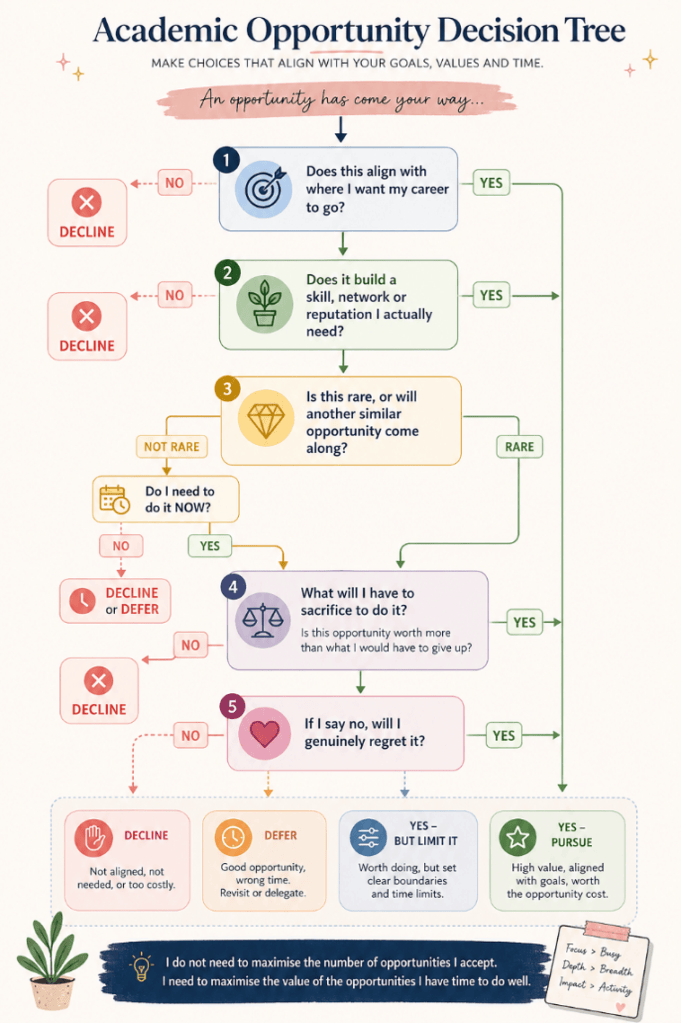
Rather than relying on how exciting an opportunity sounds in the moment, we thought it would be useful to have a practical decision-making tool. Something you could use when an opportunity lands in your inbox to interrupt the automatic “Yes, that sounds great” response. After the workshop, I turned that idea into an Academic Opportunity Decision Tree.
The idea is simple: before saying yes, work through five questions.
1. Does this align with where I want my career to go?
Not every interesting opportunity needs to become part of my career.
If I can’t see how something connects to the direction I want to move in, that’s a pretty good reason to say no.
This question is about distinguishing interesting from strategically useful.
2. Does it build a skill, network or reputation I actually need?
Is this something I genuinely need to develop?
There is a difference between building a broad portfolio of experiences and continually collecting things simply because they might be useful.
3. Is this a rare opportunity?
Some opportunities genuinely don’t come around very often.
Others will.
So if an opportunity isn’t particularly rare, I can ask:
Do I need to do this now?
If the answer is no, I can let it pass, or come back to it another time, rather than squeezing it into an already-full calendar.
4. Will I have to sacrifice a current commitment to do it?
This might be the most important question for an Academic Juggler.
Because saying yes doesn’t magically create more time.
If I take this on, what am I giving up? Will I have less time to write? Will another commitment suffer? Will I have to rush something that deserves more attention? Will I be taking time away from something that is actually a higher priority?
There is no secret second version of my week where I suddenly have an extra ten hours.
If something has to give, I need to know what it is before I say yes.
5. If I say no, will I genuinely regret it?
Finally, the gut check.
If I turn this opportunity down, will I genuinely wish I’d said yes? Or am I saying yes because I’m worried about missing out? Because I don’t want to disappoint someone? Because it feels uncomfortable to turn down something that sounds impressive? Or because I’ve somehow started equating being busy with being productive?
Sometimes, no really is the right answer.
The lesson I took from the workshop wasn’t that I need to become better at juggling. The workshop encouraged us to recognise when our strengths can become unhelpful.
And if you’re an Academic Juggler too, I’ve made the decision tree for you. Use it the next time an interesting opportunity lands in your inbox — particularly when your immediate reaction is “Yes, absolutely!”
It might just be worth pausing before you spend your time and efforts on another application.


Leave a comment